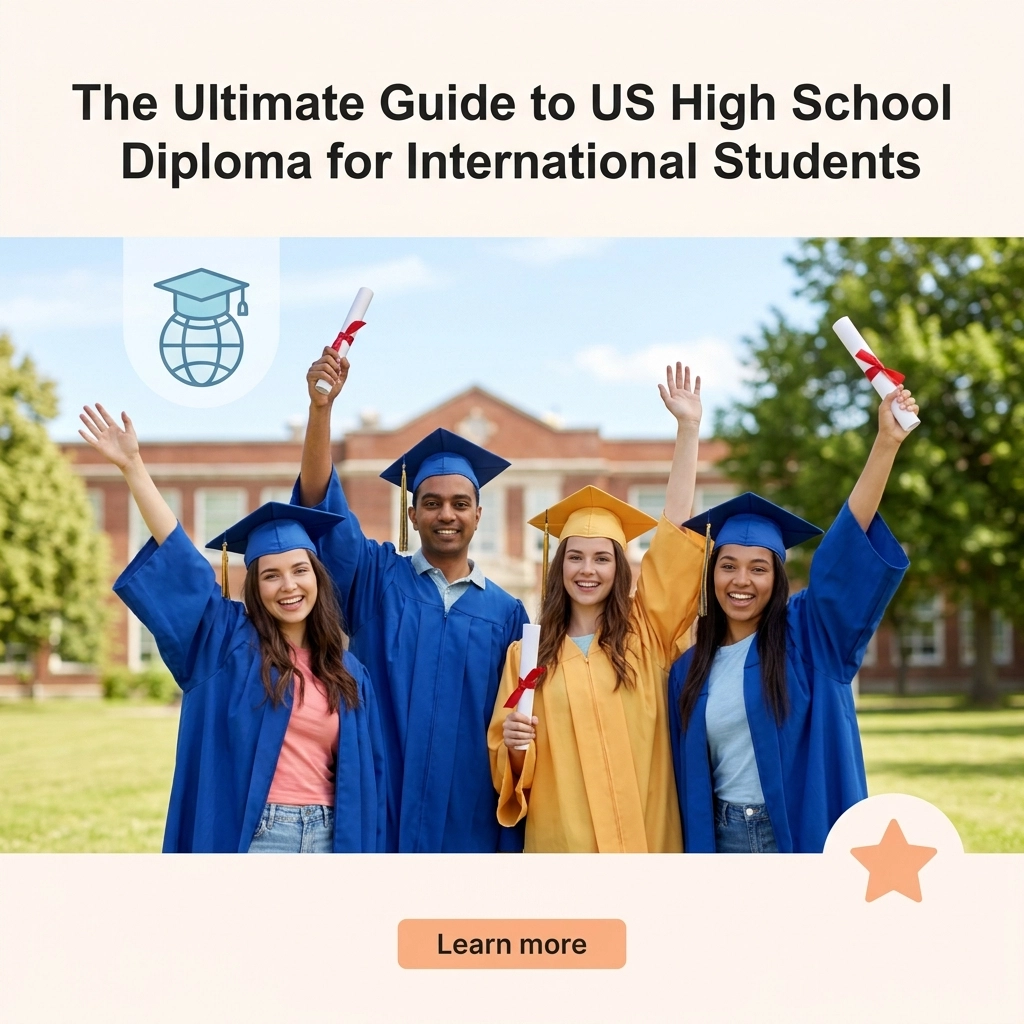
The Ultimate Guide to US High School Diploma for International Students: Everything You Need to Succeed
Friday, 1 of May 2026 | New York, USA
A US High School Diploma for International Students is a globally recognized secondary education credential awarded to students who successfully complete the required curriculum of a United States-based high school. This qualification serves as a critical bridge for students outside the United States who seek to pursue higher education at American universities or improve their professional prospects in a globalized economy.
The pursuit of a US High School Diploma for International Students provides a rigorous academic foundation characterized by a diverse range of subjects and a focus on critical thinking. For many, this diploma is the standard requirement for university admissions and is a significant indicator of English language proficiency and academic readiness.
Understanding the US High School Structure
The United States secondary education system typically encompasses four years of study, known as grades 9 through 12. During these years, students are expected to accumulate a specific number of credits in core subjects to qualify for graduation and receive their US High School Diploma for International Students.
Academic subjects are generally categorized into mandatory core requirements and elective courses. Core requirements usually include English Language Arts, Mathematics, Science, and Social Studies, while electives allow students to explore specialized interests such as technology, the arts, or foreign languages.
Credit Requirements and Graduation Standards
To earn a US High School Diploma for International Students, a student must satisfy the credit requirements established by the state or the specific accrediting body of the school. Most programs require a minimum of 22 to 24 credits.
One credit is typically equivalent to a full year of study in a particular subject. International students must ensure that their previous coursework is accurately assessed through a transcript evaluation to determine how many credits will transfer toward their US graduation requirements.
Pathways to Earning the Diploma
There are several academic pathways available for individuals seeking a US High School Diploma for International Students. Each pathway offers different levels of flexibility and immersion, depending on the student's geographic location and financial resources.
Traditional On-Campus Enrollment
This pathway involves physically attending a high school within the United States. To pursue this option, students must obtain an F-1 or J-1 visa and demonstrate the financial capacity to cover tuition and living expenses. This immersion provides a direct experience of American culture and the educational environment.
Online High School Programs
Accredited online high school programs have become an increasingly popular method for obtaining a US High School Diploma for International Students. These programs allow students to remain in their home countries while completing a US curriculum through digital platforms.
Online learning offers significant flexibility, enabling students to balance their studies with local school requirements or personal commitments. It is a cost-effective alternative to traditional on-campus education while maintaining the same academic standards.

The Importance of an Accredited US Diploma
When selecting a program, it is imperative to ensure that the institution provides an accredited US diploma. Accreditation is a formal review process conducted by recognized regional or national agencies to ensure that the educational institution meets specific standards of quality and rigor.
An accredited US diploma is essential for university admissions. Most colleges and universities in the United States and abroad will only recognize high school credentials from institutions that hold valid accreditation. Without this verification, the diploma may not be accepted for higher education or employment purposes.
Verifying Accreditation Status
International students should verify the accreditation of their chosen school through official databases. Organizations such as Cognia, the Middle States Association, or the Western Association of Schools and Colleges (WASC) are common accrediting bodies.
Educlive provides guidance on navigating these requirements to ensure that students invest their time in programs that yield a valid and recognized US High School Diploma for International Students. More information about our commitment to academic standards can be found on our About page.
Navigating the Transcript Evaluation Process
The transcript evaluation is a fundamental step for any international student transitioning into the US educational system. This process involves a formal review of a student's previous academic records from their home country to determine their equivalence in the US system.
A professional transcript evaluation ensures that students receive proper credit for the work they have already completed. This prevents the unnecessary repetition of courses and allows for a more efficient path toward graduation.
Required Documentation for Evaluation
To facilitate an accurate transcript evaluation, students typically need to provide the following:
- Official academic transcripts from all previous secondary schools attended.
- Certified English translations of all documents not originally in English.
- A description of the grading scale used by the home country's educational institution.
- Course descriptions or syllabi for specific subjects if requested by the evaluating body.
Proper documentation is the cornerstone of a successful transition to a US High School Diploma for International Students. For assistance with this process, students may explore the resources available at the Educlive Blog.
Specialized Academic Considerations: NCAA Approval
For student-athletes who aspire to compete in college sports in the United States, obtaining a diploma from an NCAA approved high school is a mandatory requirement. The National Collegiate Athletic Association (NCAA) has strict eligibility standards regarding the types of courses and the quality of instruction a student must receive.
An NCAA approved high school must have its curriculum and instructors vetted by the NCAA Eligibility Center. If a student completes their US High School Diploma for International Students at a non-approved institution, they may be ruled ineligible to receive athletic scholarships or participate in collegiate sports.
Maintaining Athletic Eligibility
Student-athletes should proactively confirm that their online or on-campus program is listed in the NCAA directory of approved schools. This involves checking specific course codes to ensure they meet the "core course" definitions required for Division I and Division II athletics.

Core Subjects and Academic Rigor
The curriculum required for a US High School Diploma for International Students is designed to provide a comprehensive education. Proficiency in English is a primary focus, as it serves as the language of instruction for all other subjects.
- English Language Arts: Focuses on literature, composition, and rhetorical analysis.
- Mathematics: Includes Algebra I, Geometry, Algebra II, and often Pre-Calculus or Statistics.
- Science: Typically requires courses in Biology, Chemistry, and Physics.
- Social Studies: Covers US History, World History, Government, and Economics.
Mastery of these subjects is essential for students to demonstrate their readiness for the academic demands of higher education. Educlive offers specialized support for these subjects through its portfolio of educational services.
Eligibility and Admission Requirements
To enroll in a program leading to a US High School Diploma for International Students, applicants must meet specific eligibility criteria. While requirements vary by institution, most programs adhere to a standard set of prerequisites.
Standard Admission Criteria
- Age Requirement: Most high school programs cater to students between the ages of 14 and 18. Adult learners may need to seek specialized adult high school or GED programs.
- Educational History: Applicants must have successfully completed the equivalent of 8th grade.
- English Proficiency: Students may need to demonstrate their ability to understand and communicate in English through standardized tests such as the TOEFL or IELTS.
- Financial Documentation: For on-campus students, proof of funds is required for visa processing.
International students should also be prepared to submit a photocopy of their passport and proof of residency as part of the enrollment process for a US High School Diploma for International Students.

The Step-by-Step Enrollment Process
Securing a US High School Diploma for International Students requires a methodical approach to application and enrollment. Following these steps ensures that all legal and academic requirements are satisfied.
- Research and Selection: Identify an accredited institution that meets your academic and career goals.
- Request Transcript Evaluation: Submit your previous records for a formal transcript evaluation to determine your standing.
- Submit Application: Complete the school’s application forms and provide necessary identification.
- Demonstrate Language Proficiency: Provide scores from English language assessments if required.
- Enroll in Courses: Once accepted, select your courses based on the remaining credits needed for graduation.
- Maintain Academic Progress: Consistently engage with the curriculum and meet all assessment deadlines.
For those interested in how Educlive is expanding access to these pathways in regions like West Africa, please refer to our article on transforming academic access in Monrovia.
Support Systems for International Learners
Achieving a US High School Diploma for International Students can be challenging due to linguistic and cultural differences. Therefore, access to robust support systems is vital for student success.
Personalized academic coaching and tutoring can help students bridge gaps in their understanding of the US curriculum. One-on-one guidance is particularly effective for complex subjects or for mastering the nuances of American academic writing.
Personalized Academic Coaching
Effective coaching involves more than just tutoring; it includes helping students develop soft skills such as time management and digital literacy. These skills are essential for navigating online platforms and succeeding in a self-paced environment. Explore more about soft skills development and how they contribute to academic transformation.

Financial Considerations and Scholarships
The cost of obtaining a US High School Diploma for International Students varies significantly. Online programs generally offer a more affordable tuition structure compared to private US boarding schools or day schools.
Students should investigate potential scholarship opportunities or financial aid programs offered by their chosen institution. Investing in an accredited US diploma is a long-term financial decision that can lead to increased earning potential and access to high-tier university scholarships in the future.
Conclusion: Your Pathway to Academic Transformation
Obtaining a US High School Diploma for International Students is a transformative academic milestone that opens doors to prestigious universities and global career opportunities. By ensuring you enroll in an accredited US diploma program, undergoing a professional transcript evaluation, and choosing an NCAA approved high school if necessary, you position yourself for long-term success.
The journey requires dedication, rigorous study, and a clear understanding of the US educational framework. However, with the right resources and support, international students can successfully navigate this path and achieve their educational ambitions.
For comprehensive support and to begin your journey toward a US High School Diploma for International Students, visit Educlive today. We are committed to bridging the gap and providing the tools necessary for your academic transformation. Explore our expansion plans for West Africa to see how we are bringing these opportunities to more students globally.