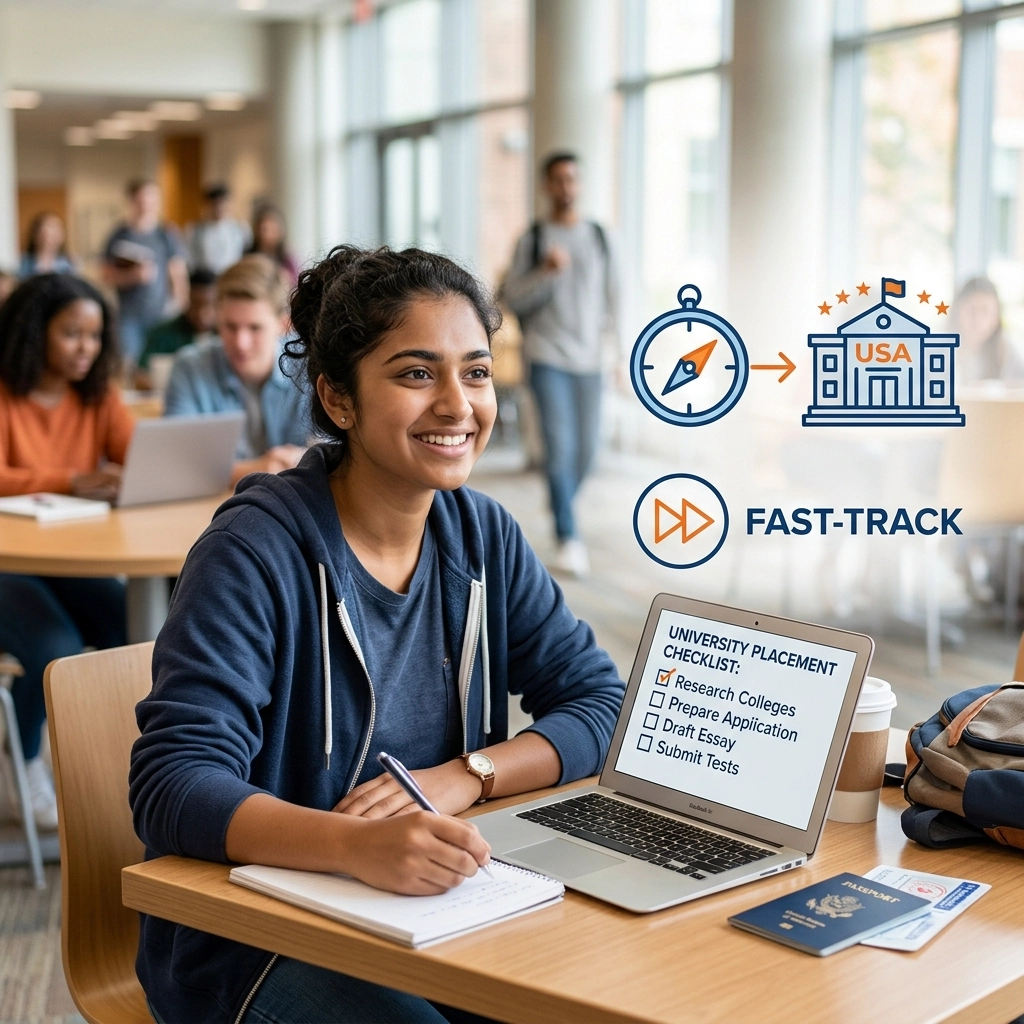
How to Fast-Track Your USA University Placement as an International Student
New York, USA – May 15, 2026
The decision to study in USA represents a pivotal moment in an international student’s academic and professional journey. To fast-track a USA university placement, students must navigate a complex series of requirements ranging from transcript verification to visa acquisition. This guide provides a structured framework for accelerating the enrollment process while ensuring all academic standards are met.
Academic transformation begins with a clear understanding of the timelines and prerequisites involved in the American higher education system. By adopting a proactive strategy, students can significantly reduce the time between application and arrival on campus.
Defining the Fast-Track Strategy
A fast-track approach to university placement does not involve bypassing essential requirements but rather optimizing the sequence of actions taken by the applicant. For many, the goal to study in USA is driven by the desire for early start dates and minimal delays in academic progression.
Efficiency in this context is often defined by choosing institutions with flexible intake periods and streamlined admissions processes. Success requires the parallel processing of documents, early engagement with credential evaluation services, and a focused approach to standardized testing.
Prioritizing Rolling Admissions for Immediate Results
Rolling admissions is an enrollment policy used by many colleges where applications are reviewed as they are submitted, rather than after a fixed deadline. This system allows for a faster turnaround in admission decisions, often providing results within a few weeks of submission.
Institutions that utilize rolling admissions offer a distinct advantage for those who wish to study in USA without waiting for the traditional fall semester cycle. These universities often accept applications throughout the year until all slots are filled.
- Faster Response Times: Decisions are typically communicated within two to six weeks.
- Reduced Competition: Applying early in a rolling cycle increases the likelihood of securing a spot.
- Multiple Entry Points: Many schools offer spring and summer start dates in addition to the fall.

The Essential Role of Credential Evaluation Services
Credential evaluation is the process of converting foreign academic qualifications into their United States equivalents. For international students, utilizing credential evaluation services is a mandatory step for demonstrating academic eligibility to admissions committees.
These services ensure that a student's previous education is recognized and understood by American registrars. Without a standardized evaluation, the university may not be able to accurately determine a student's grade point average (GPA) or course credits, which are vital for a successful study in USA experience.
- Selection of Agency: Students must use agencies recognized by the National Association of Credential Evaluation Services (NACES).
- Document Submission: Original transcripts and degree certificates must be submitted for official review.
- Course-by-Course Analysis: This specific type of evaluation is usually required for university transfer students to ensure credit portability.
By engaging these services early in the process, students prevent administrative bottlenecks that often delay USA university placement.
Streamlining English Proficiency and Standardized Testing
To study in USA, non-native speakers must demonstrate a high level of English language proficiency. Standardized tests such as the TOEFL, IELTS, or the Duolingo English Test are the primary methods for meeting this requirement.
To accelerate the placement process, students should target universities that accept the Duolingo English Test, which provides results in as little as 48 hours. Furthermore, many institutions have moved toward "test-optional" or "test-free" policies, eliminating the need for the SAT or GRE.
- Test Waivers: Some universities waive English tests if the student's previous education was conducted entirely in English.
- Conditional Admission: Students may receive an offer of admission contingent upon completing an intensive English program on campus.
- Focused Selection: Prioritizing schools that do not require time-consuming entrance exams allows for a more rapid application cycle.

Utilizing Pathway and Accelerator Programs
Pathway programs, also known as International Year One programs, provide a bridge for students who may not meet the full academic or linguistic criteria for direct entry. These programs are specifically designed to help students transition into the American university system while earning credits toward their degree.
These programs often facilitate a faster USA university placement because they have more flexible admission criteria and dedicated support staff. For those intending to study in USA, pathway programs offer a structured environment that combines English language training with core academic subjects.
- Guaranteed Progression: Successful completion of the pathway program usually guarantees entry into the second year of a bachelor’s degree.
- Predictable Timelines: These programs often have multiple start dates throughout the academic year.
- Academic Support: Students receive additional coaching to ensure they maintain the GPA required for full university standing.
Strategic Documentation and Financial Planning
The issuance of an I-20 form: the document required to apply for a student visa: is contingent upon the submission of valid financial records. To study in USA, students must prove they have the necessary funds to cover tuition and living expenses for at least one academic year.
Preparing financial documentation in parallel with academic applications is a critical component of the fast-track method. Delays in proving financial solvency are a common cause for postponed start dates.
- Bank Statements: Must be recent and clearly show the available balance in a convertible currency.
- Sponsor Letters: If a third party is funding the education, a notarized letter of support is essential.
- Scholarship Awards: Official notification of any institutional aid should be included in the financial file.

The Community College Transfer Route
For many international students, starting at a community college is the most efficient way to study in USA. Community colleges offer two-year associate degrees and maintain "articulation agreements" with four-year universities, ensuring a seamless transfer process.
This route is often faster because community colleges typically have simpler application requirements and lower tuition costs. It allows students to begin their USA university placement journey immediately while improving their academic profile for a later transfer to a prestigious institution.
Navigating the F-1 Visa Timeline
The final hurdle for those who wish to study in USA is the F-1 student visa interview. After receiving the I-20 form from a university, the student must pay the SEVIS fee and schedule an appointment at the nearest U.S. embassy or consulate.
To avoid delays, students should monitor visa appointment wait times in their respective countries. Booking the interview as early as possible is necessary, as seasonal backlogs can extend wait times by several months.
- SEVIS I-901 Fee: This fee must be paid before the visa interview can take place.
- Form DS-160: The online non-immigrant visa application must be completed accurately.
- Interview Preparation: Students must be prepared to demonstrate their intent to return home after their studies and their academic readiness.

How Educlive Supports Your Academic Transformation
Educlive is dedicated to transforming academic access for students worldwide. Whether you are seeking a U.S. High School Diploma or specialized coaching for university entry, our platform provides the tools necessary for success. We understand that the path to study in USA requires precision and professional guidance.
Our initiatives, such as the Educlive expansion plan for West Africa, aim to bridge the gap between international talent and global educational opportunities. We assist students in navigating credential evaluation services and selecting the right pathways for their career goals.
If you are ready to begin your journey, explore our academic portfolio to find the program that fits your needs. Our team is committed to helping you achieve a successful USA university placement through mastery-based learning and personalized support.
Summary of the Fast-Track Pathway
To fast-track your university placement and successfully study in USA, follow these high-level steps:
- Identify institutions with rolling admissions and multiple intake dates.
- Initiate credential evaluation services for all non-U.S. academic documents immediately.
- Prepare financial evidence early to ensure the prompt issuance of the I-20 form.
- Consider community colleges or pathway programs to overcome initial entry barriers.
- Maintain a strict schedule for standardized testing and visa applications.
By adhering to a structured and proactive plan, international students can effectively manage the complexities of the American admissions process. The journey toward a degree in the United States is one of rigorous preparation, but with the right strategy, your academic goals are well within reach.
For more information on academic success and educational trends, visit our blog for regular updates and insights.